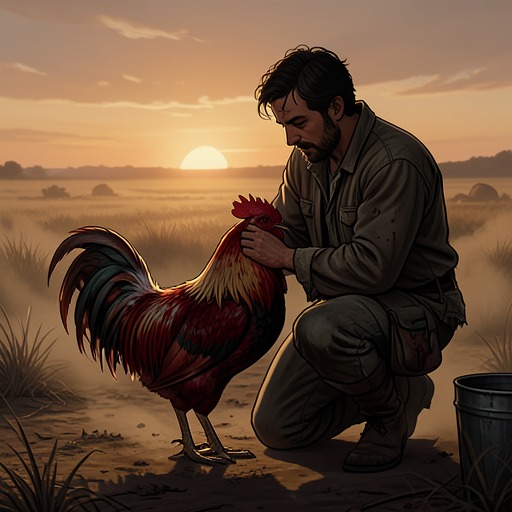
“Macho kills the black one—is a game. The other one kills Macho—is not a game.”
Cry Macho“Macho kills the black one—is a game. The other one kills Macho—is not a game.” is Rafo’s compressed distinction between play and lethal consequence. Spoken after a vulture has seized a rooster, the expression connects the familiar contest involving Macho with an event that has made the rules of a game seem inadequate. Its significance lies not only in what Rafo says, but in the correction it prompts Mike to confront: the boy’s experience has contradicted what Mike told him about vultures, and Mike knows that reassurance cannot hold.
The Expression in Context
The remark comes while Mike and Rafo sit in the back of the truck eating. Rafo has said he is hungry, but eats only a few Fritos and drinks part of an Orange Crush. Then he falls quiet and asks why the vulture did not kill its prey immediately. The scene gives the expression its immediate concern: Rafo is trying to make sense of an encounter he finds troubling, rather than simply commenting on the outcome of a contest.
His reasoning develops in stages. He says that animals should be killed quickly, then observes that some people do the same. The narration suggests possible connections to other acts of killing, including Marta’s decision to kill a cow before setting fire to the jacal, but does not establish exactly what Rafo is remembering. That uncertainty matters. The expression is not presented as a settled explanation of his thoughts; it is a compact judgment spoken while he is still trying to understand what he has seen.
Game and Consequence
The sentence turns on a contrast between two outcomes involving Macho. When Macho kills the black rooster, Rafo calls it a game; when the other animal kills Macho, he says it is not. The repeated structure makes the reversal plain: an action that belongs to a contest from one position can become a real and consequential loss from another. The same word, game, cannot contain both outcomes.
The expression therefore does more than label a difference between winning and losing. It marks the point where the boundary between play and life-or-death consequence breaks down. Rafo’s distinction is emotionally direct, but the passage does not resolve every ambiguity in it: the boy may be weighing the immediate attack, the earlier contests, or the wider question of why some deaths are treated as entertainment and others as suffering. The text anchors these readings in his effort to understand the scene without claiming that he articulates a complete theory.
Mike’s Unspoken Answer
Rafo’s observation also exposes a failure in Mike’s earlier account. Mike had told him that vultures feed on dead things, not living ones. When the bird attacks a living animal, Rafo appears close to asking how that claim can be reconciled with what he has witnessed. Mike anticipates the question and, in his thoughts, admits that he was wrong: the rules he had given Rafo do not apply when vultures are starving and will attack whatever they can.
That recognition gives the expression a second force. Rafo speaks about what is and is not a game; Mike silently recognizes that the rules he supplied were not reliable protection against the world’s behavior. His spoken reply to Rafo’s earlier question is that he does not know. The more complete answer remains unspoken, so the passage makes Mike’s awareness of his own error part of the scene without turning it into a speech that Rafo receives.
Silence and Significance
Rafo does not ask the question Mike expects. The narration leaves open whether he has forgotten it or is choosing to spare Mike; either possibility makes his silence consequential. He finishes his drink, says he is sleepy, and gets into the sleeping bag. Mike lies beside him on the truck floor, determined to stay awake in case Rafo needs him. The exchange thus ends not with an explanation that repairs the contradiction, but with Mike’s practical choice to keep watch.
As an expression, the line gathers the passage’s contrast between a contest’s apparent rules and harm that cannot be contained by them. Its balance and repetition make the distinction memorable, while its setting keeps it personal: Rafo is trying to understand a disturbing event, and Mike is confronting the limits of what he had told the boy. The phrase does not erase that uncertainty or make the loss a game after all. It names the moment when Rafo recognizes that the stakes have changed.